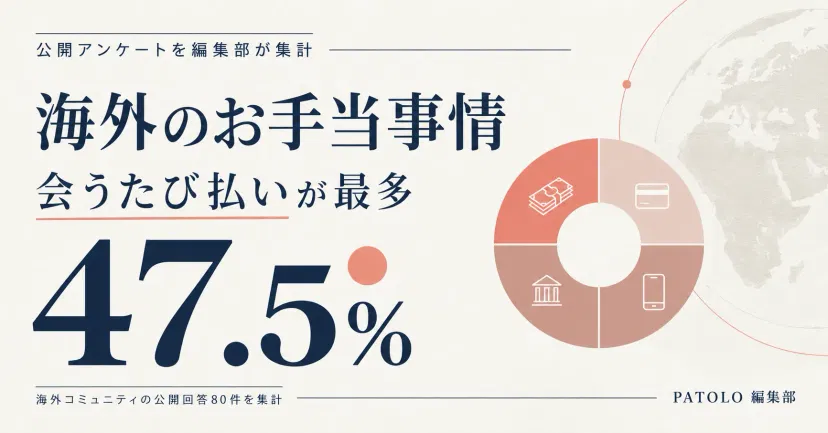
The editorial team of PATOLO, a screening-based matching service operated by UNIVERSE GROUP, compiled 80 responses to a survey on allowances published in overseas online communities.
This article summarizes information about sugar dating, a type of relationship in English-speaking countries, including payment methods, amounts by country, satisfaction levels, and how to reveal your identity, all in Japanese.
In addition to simply listing the numbers, PATOLO editor Kotetsu has included his interpretation of each result.
Finally, based on overseas data, we have summarized the PATOLO editorial team's perspective on what those who engage in "sugar dating" in Japan can take away from their experiences.
Key points of the survey results
- The most common method of payment is "payment each time we meet" at 47.5%, while monthly and weekly payments together account for 46.3%.
- In the Philippines, Mexico, and India, the average cost per session was between 20,000 and 30,000 yen in 9 out of 14 cases. Even within the same country, there is a difference of more than 10 times.
- Satisfaction with the price (on a 10-point scale) was 6.1 for women and 7.4 for men. Satisfaction with the time spent together was almost the same for both men and women.
- 36.3% of relationships are less than a month old. 12.5% of relationships have lasted for more than a year.
- 80.6% of women know their partner's true identity. Among Japanese PATOLO female members, 34.3% tell their partner their real name.
Overseas, it's called "sugar dating." The one paying is called a sugar daddy, and the one receiving is called a sugar baby.
What is known as "papa katsu" in Japan is called "sugar dating" in English-speaking countries.
The person paying the allowance is called a "sugar daddy," the person receiving it is called a "sugar baby," and the arrangement between the two is called an "arrangement." This survey also uses these terms to ask respondents about their position.
While there is a matching app in Japan called "Sugar Daddy," the term "sugar daddy" in this article refers to the more common English term.
Result 1: The most common method of payment is "payment each time we meet." However, monthly and weekly payments are also common.
There were four ways to pay the allowance.
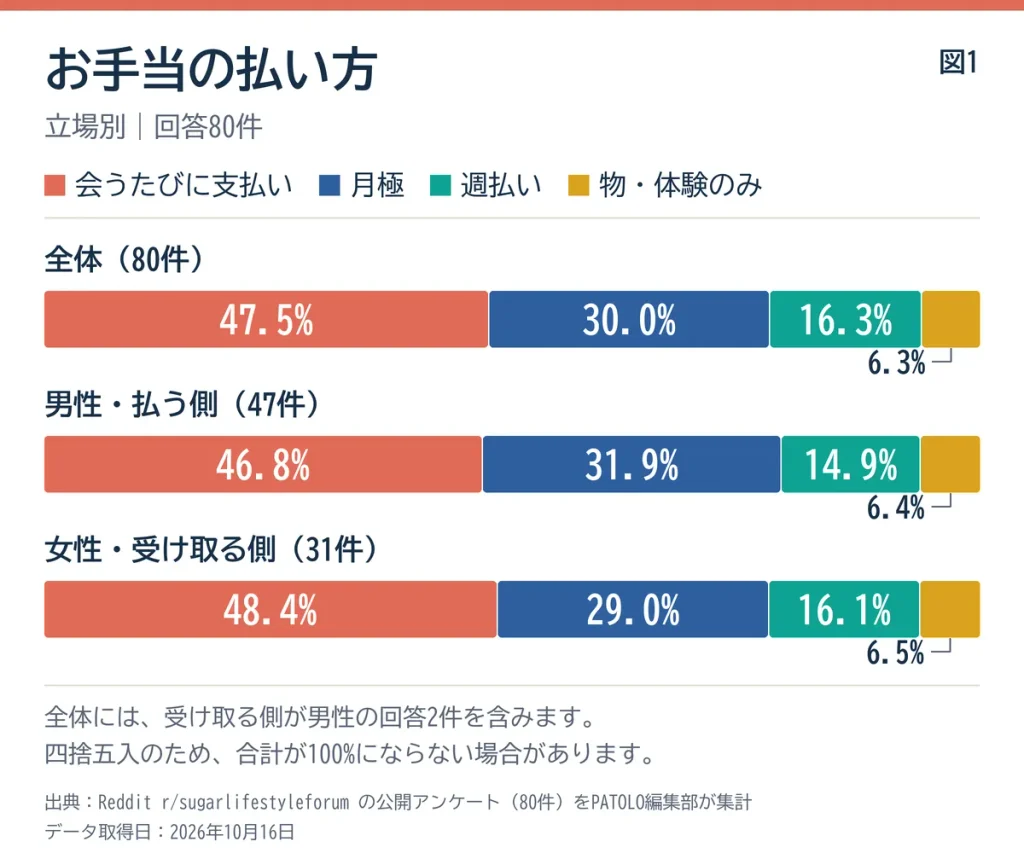
The most common method is payment each time they meet (38 cases, 47.5%), followed by monthly payments (24 cases, 30.0%), weekly payments (13 cases, 16.3%), and giving only goods or experiences (5 cases, 6.3%).
Looking at the data by gender, the most common method remains the same: payment is made each time they meet (48.4% for women, 46.8% for men).
By region, in Asia, payment each time a meeting is made was the most common at 59.4%, while in Central and South America, monthly payments were the most frequent at 40.7%.
PATOLO's opinion
In English-speaking countries, this relationship is called an arrangement.
The fact that nearly half of the responses indicated that they decide on a fixed amount for each period, whether monthly or weekly, suggests that there is a culture of defining the form of the relationship from the outset, as the terminology itself implies.
There's nothing wrong with exchanging money each time you meet. What's important isn't the payment method itself, but whether both people understand the frequency of meetings and the amount involved.
In Japan, too, if you get this sorted out before meeting someone, it's less likely that things will turn out differently than you expected later on.
Comparison with Japan
A survey conducted by PATOLO among its female members revealed that approximately 9% received payment each time they met.
In responses from overseas, 52.5% of cases involved payment methods other than per-meeting payments (monthly, weekly, or for goods or experiences), suggesting that lump-sum payments for specific periods are more common than in Japan.
However, since the two surveys use different question wording and have different respondents, please view the numbers as a general trend.
Result 2: The majority of responses indicated an amount of 20,000 to 30,000 yen per session. However, there was significant variation even within the same country.
For the five countries that received five or more responses, we converted the amounts to Japanese yen. Since the survey did not specify a currency, the editorial team determined whether the responses were in US dollars or the respective country's currency, and only used the responses for which this determination could be made.
Because the values of US dollars and Singapore dollars are close and indistinguishable in Singapore, the range shown is the conversion range using both currencies (see the survey overview at the end for the determination method).
| Country | Per meeting (payment each time you meet) | Monthly |
|---|---|---|
| Philippine | Approximately 1.6 to 7.9 yen (5 cases) | Approximately 7.9 to 15.8 yen (3 cases) |
| Mexico | Approximately 2.1 to 3.2 yen (3 cases) | Approximately 4.7 to 11.1 yen (3 cases) |
| India | Approximately 0.6 to 19.0 yen (6 cases) | Approximately 5.0 to 23.7 yen (3 cases) |
| Columbia | No Answer | Approximately 10.0 to 79.0 yen (3 cases) |
| Singapore | Approximately 4.9 to 12.6 yen (3 items; currency cannot be determined, so it is shown as a range) | Not published due to only one response. |
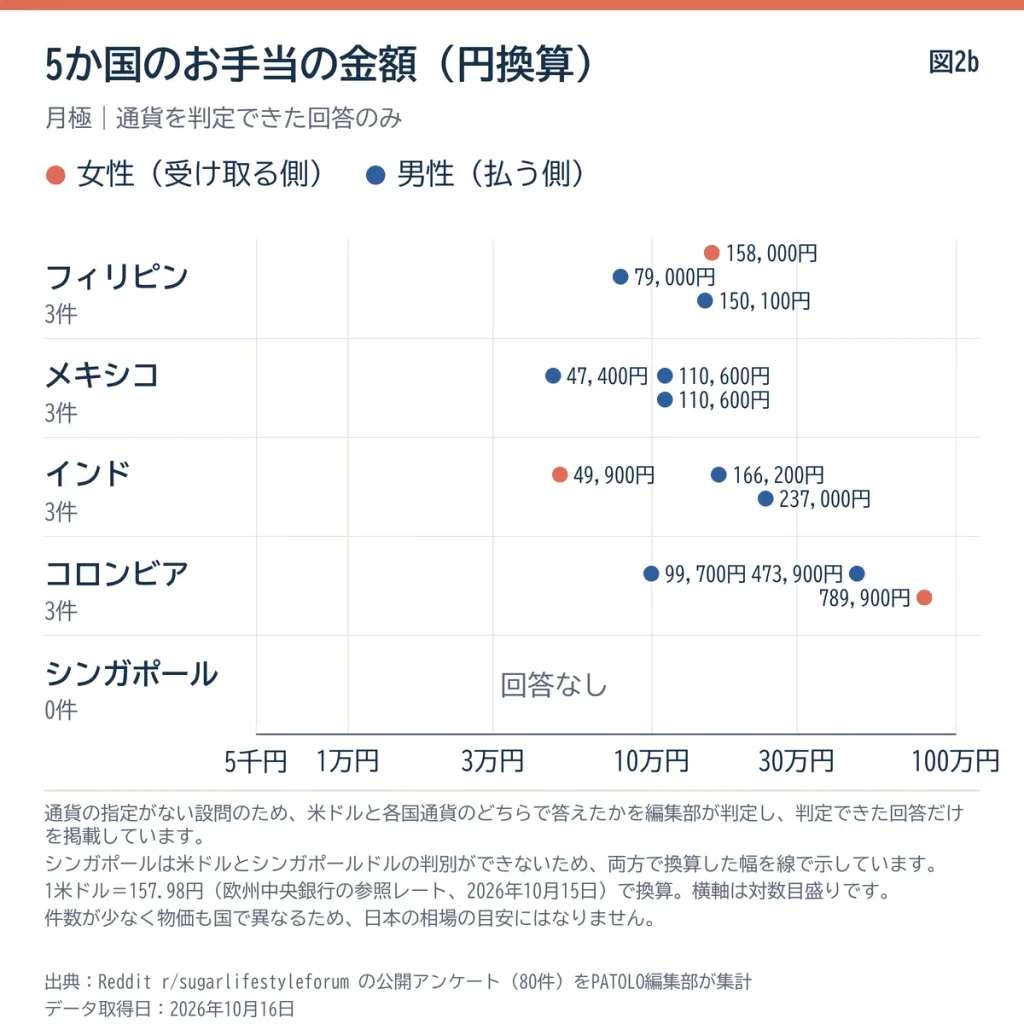
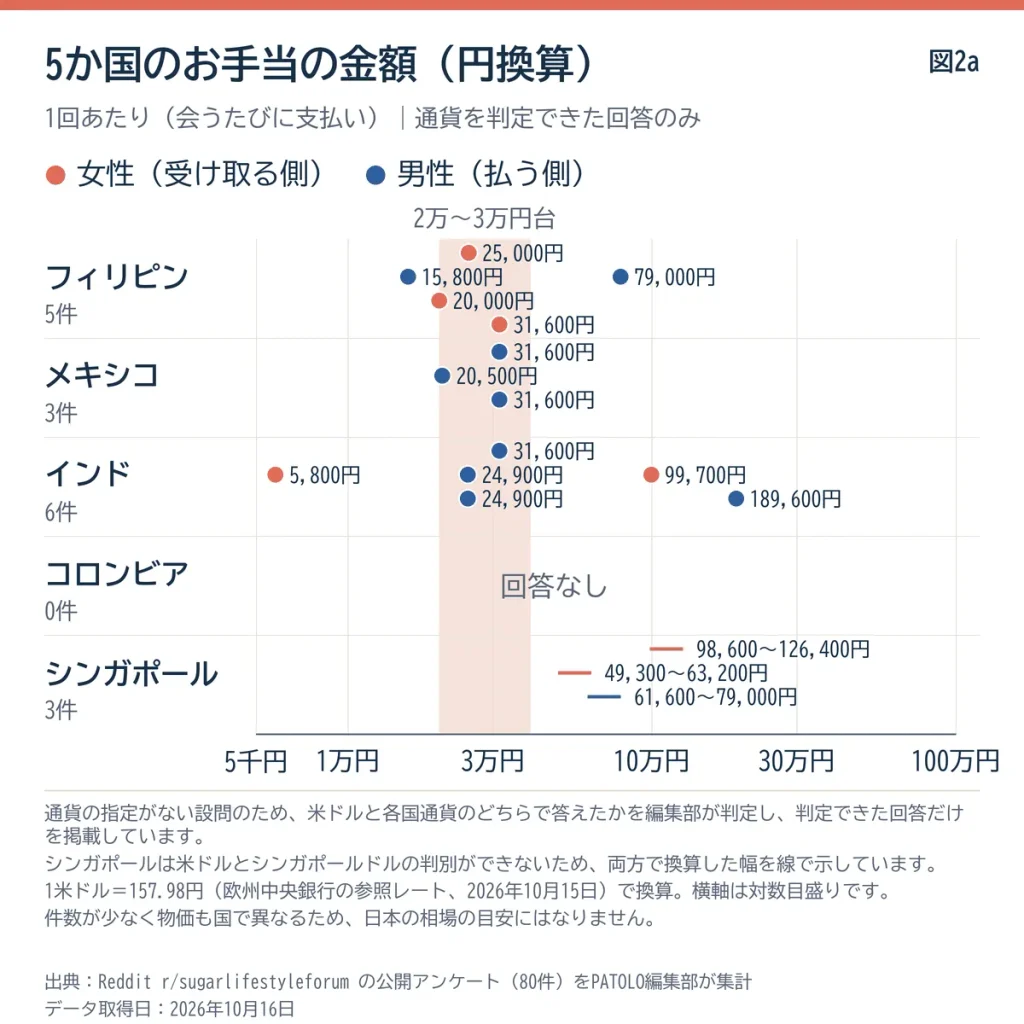
In the Philippines, Mexico, and India, 9 out of 14 responses indicated an average cost of 20,000 to 30,000 yen per session. However, even within the same country, there were responses showing a difference of more than tenfold.
Because the number of responses is small and prices vary from country to country, please read this amount as "within the range of responses from these 80 people" and do not use it as a guideline for Japanese prices.
PATOLO's opinion
While some amounts may appear similar to those in Japan when converted to yen, prices vary greatly from country to country, so it's impossible to say that "things are more expensive" or "things are cheaper overseas." What was more striking was the fact that prices within the same country could differ by more than tenfold.
The going rate is merely a guideline; the actual amount largely depends on the terms and agreements of the two parties involved. I believe this is the same both overseas and in Japan.
I recommend that you don't make decisions based solely on the figures in the price list, but rather consider them in light of your own and the other party's conditions.
Result 3: Women are less satisfied with money. Satisfaction with time is almost the same for both men and women.
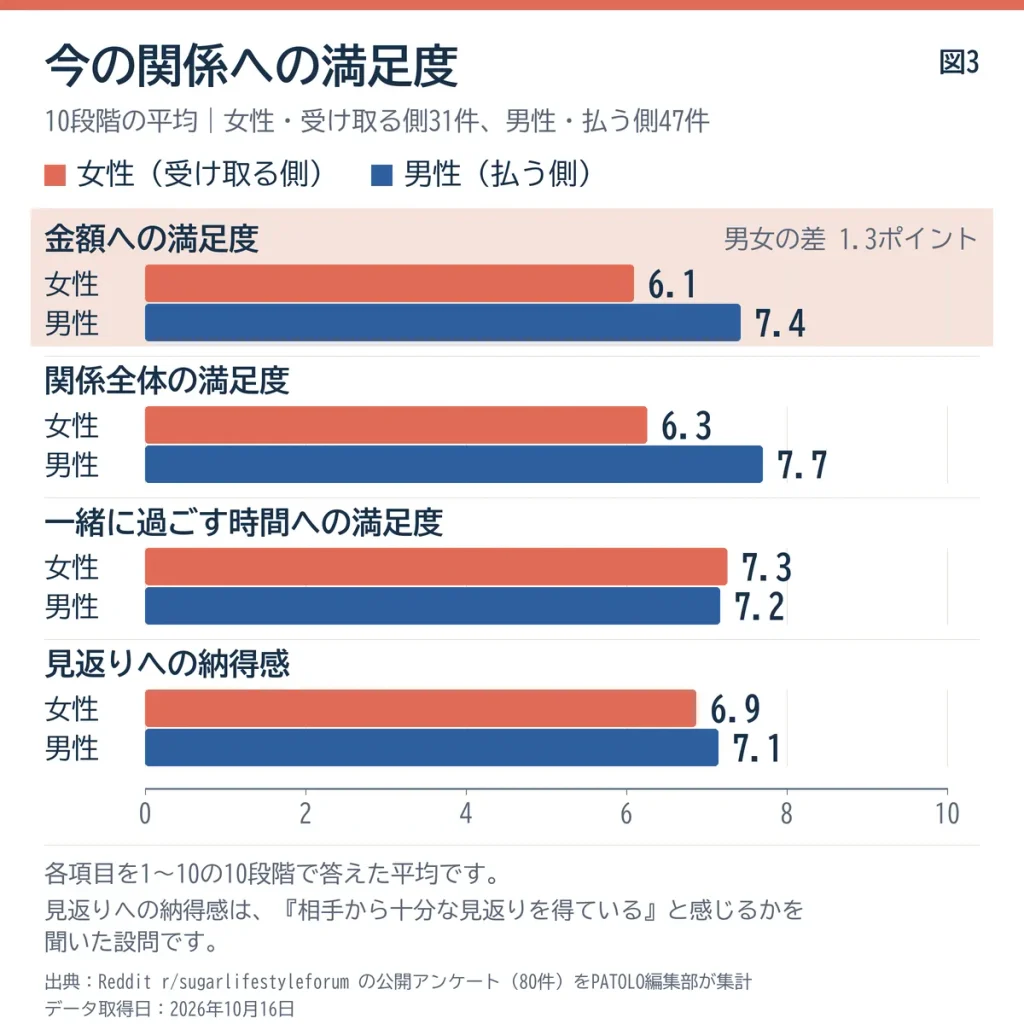
In a question asking about satisfaction with the current relationship on a 10-point scale, the average satisfaction with the amount of money was 6.1 for women and 7.4 for men. The result shows that those receiving the allowance are less satisfied with the amount.
On the other hand, satisfaction with the time spent together was almost the same for both men and women, at 7.3 for women and 7.2 for men. This suggests that satisfaction with the relationship itself and satisfaction with the amount of money spent are considered separately.
PATOLO's opinion
This result was the most striking. While both men and women were equally satisfied with the time they spent together, women were 1.3 points lower in satisfaction with money.
It seems like the relationship itself is going well, but the issue of money is being left unresolved.
It's difficult to bring up the topic of money. However, it's better to calmly discuss things when they arise rather than continuing to meet while harboring resentment. In the end, this will likely lead to a longer-lasting relationship.
Result 4: There is a large age difference, and the relationship is short.
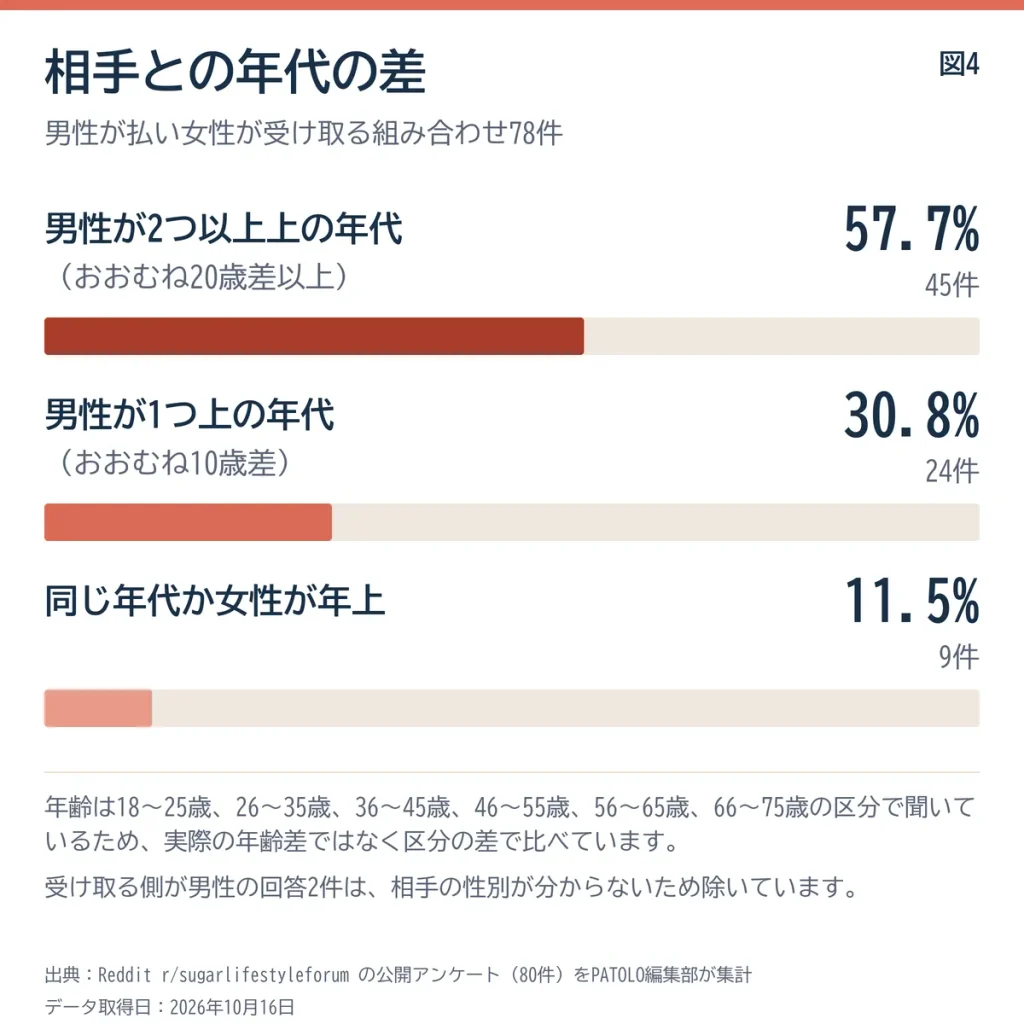
In the 78 cases where the man paid and the woman received, comparing the ages of the respondents and their partners, 45 cases (57.7%) involved the man being two or more years older (generally a difference of 20 years or more).
Only 9 cases (11.5%) involved couples of the same age or the woman being older.
Regarding the length of the relationship, 29 cases (36.3%) were less than one month, 25 cases (31.3%) were one to three months, and 10 cases (12.5%) were relationships that lasted for more than one year.
The most common frequency of meeting per month was 1-2 times, with 32 responses (40.0%).
PATOLO's opinion
More than a third of relationships last less than a month, and only about 10% last for more than a year. It seems that relationships don't last very long overseas either.
That's why it's important to check your preferences and compatibility during the first few meetings. The greater the age or social standing of the other person, the more likely it is that you'll have different ideas about what's "normal."
I believe that checking things without hesitation is helpful regardless of the country.
Result 5: In other countries, people often reveal their identities. In Japan, the majority of people conceal their real names.
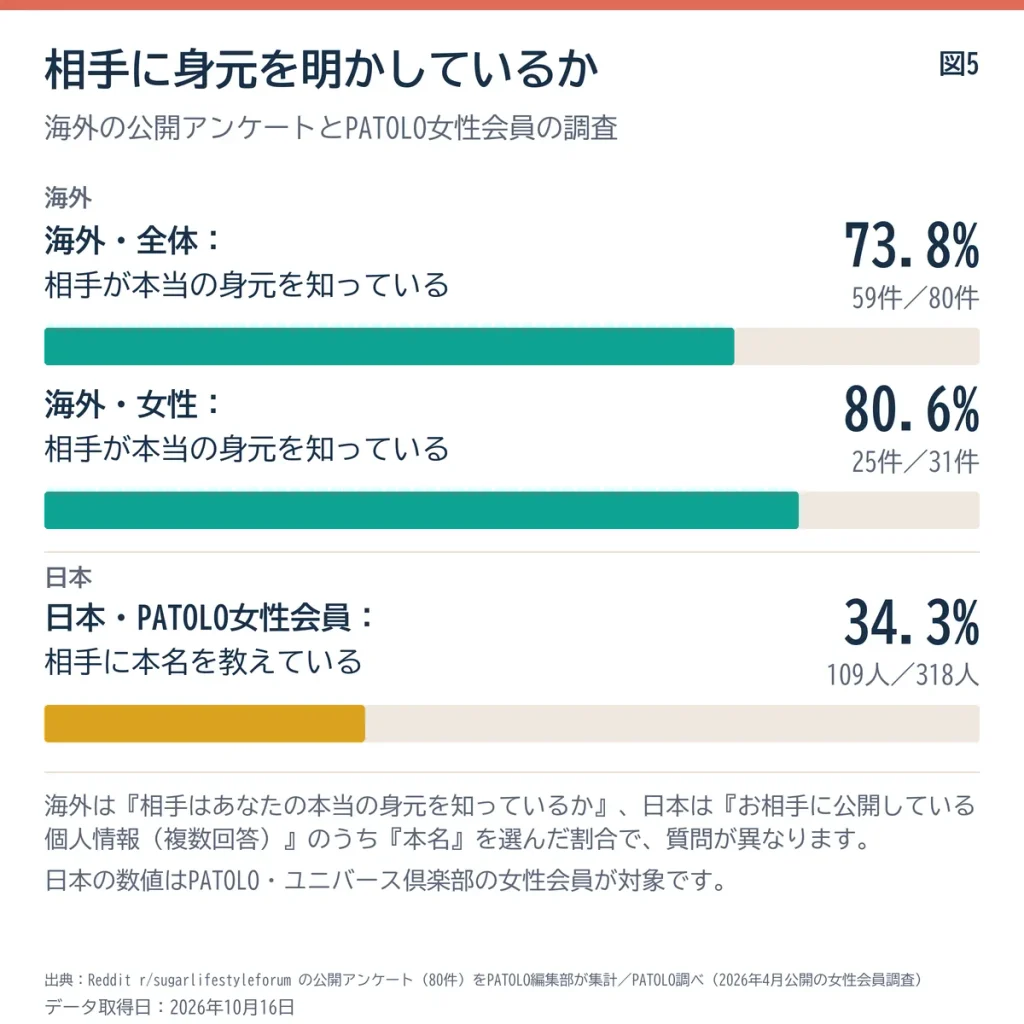
In response to the question, "Does the other person know your real identity?", 59 people (73.8%) answered "yes".
Among women, 25 out of 31 cases (80.6%) were reported, while among men, 33 out of 47 cases (70.2%) were reported.
On the other hand, in a survey conducted by PATOLO among its female members (318 respondents, multiple answers allowed), 34.3% of respondents told their real name to their partner, and 6.9% told their workplace or school name.
PATOLO's opinion
While the way the questions are asked makes a direct comparison difficult, the difference is clear. In other countries, many people continue relationships after revealing their true identities, while in Japan, more people meet while concealing their real names.
I think this reflects how much Japanese users value their privacy.
There's no single right answer to how much to reveal. However, I believe that deciding the scope of what you're revealing and gradually expanding it as your trust in the other person increases is a reasonable approach for Japanese users.
Summary: Three things Japanese users can take away from overseas data
1. Clearly state your conditions before meeting.
Overseas, the relationship is referred to as an "agreement," and nearly half of the respondents indicated that the amount for each period is decided in advance.
In Japan, a survey of female members of PATOLO revealed that 42.1% of respondents prefer to discuss compensation "before meeting," making it the most common approach.
I believe that agreeing on the frequency of meetings, how to spend time together, and the amount of money to spend before meeting is the best way to prevent misunderstandings.
2. If you have any complaints about the price, communicate them as soon as possible.
Overseas responses showed that satisfaction with time spent was almost the same for both men and women, but satisfaction with the amount of money received was 1.3 points lower for recipients. Even in good relationships, discussions about money tend to be overlooked.
I believe that being able to calmly discuss things when something comes up is also a condition for a good relationship.
3. You decide how much of your identity you will reveal.
In other countries, over 70% of relationships involve the other person knowing the other person's identity, whereas in Japan, only about one in three female members reveal their real name. How much to reveal is up to each individual. It's best to start by revealing only a limited amount and then expand once trust is established.
Therefore, one option is to choose a service that allows you to adjust the privacy settings yourself.
[Suggested inclusion of PATOLO feature introduction: PATOLO has features such as a private mode that allows you to adjust the visibility of your profile. *Please confirm the current feature names and descriptions with the administrators before including them.]
[Contextual CTA (Main appeal: Market price/allowance, Call to action: PATOLO TOP). Introduction 40-80 characters + button 12-22 characters + note immediately below 20-35 characters. Text should conform to the operator's specifications.]
Precautions when reading overseas data
This survey was conducted voluntarily by participants in an online community overseas, and the respondents were heavily skewed towards Asia and Central and South America, with very few responses from Europe or North America.
Since the number of responses per country is small, at a maximum of 12, this does not represent the overall situation overseas.
If you'd like to know the going rate for allowances in Japan, please see our survey article on allowance rates based on responses from 1,093 female PATOLO members (PATOLO survey, published April 2026).
Survey outline
| Item | Message |
|---|---|
| Data source | List of responses to the survey published in the "2023/2024 Allowance Master Thread" post on the Reddit community "r/sugarlifestyleforum" |
| Response period | January 21, 2024 to October 1, 2026 (based on the date and time of the response) |
| Number of responses | 80 cases (47 men paying the allowance, 31 women receiving it, 2 men receiving it) |
| Respondent's region | 32 cases in Asia ・27 cases in Central and South America India: 10 cases 7 cases in Africa ・Middle East 2 cases ・2 Pacific Islands |
| totalling | PATOLO Editorial Department (Data retrieved on October 16, 2026) |
| Handling of amounts | Since no currency was specified, each response was read in both US dollars and the respective national currency. If only one reading fell within the defined range for each payment method, that currency was determined. Responses that could not be determined were excluded. Responses where the recipient was male were also excluded. |
| Exchange rate | 1 US dollar = 157.98 yen 95.06 Indian Rupees 63.074 Philippine Pesos 18.5225 Mexican Pesos 1.2829 Singapore dollars (European Central Bank reference rate, October 15, 2026) 1 US dollar = 3,170.46 Colombian pesos (Central Bank of Colombia, October 16, 2026) |
| Japanese comparative data | (Survey conducted by PATOLO; published April 2026. Based on a web survey of female members of the PATOLO Universe Club, conducted from 2025 to March 2026.) |
