The editorial team of PATOLO, a screening-based matching service operated by UNIVERSE GROUP, has compiled the registered residential locations for a total of 22,457 profiles (6,059 male members and 16,398 female members) based on member data as of September 28, 2026.
Approximately 60% of both male and female members live in Tokyo, Osaka, and Aichi prefectures, while members of both sexes are present in all 47 prefectures.
This article presents the distribution and gender ratio by region and prefecture, along with the PATOLO editorial team's commentary on each result. Finally, we've summarized how to find a partner based on your location.
Result 1: 6% of members live in Tokyo, Osaka, or Aichi.
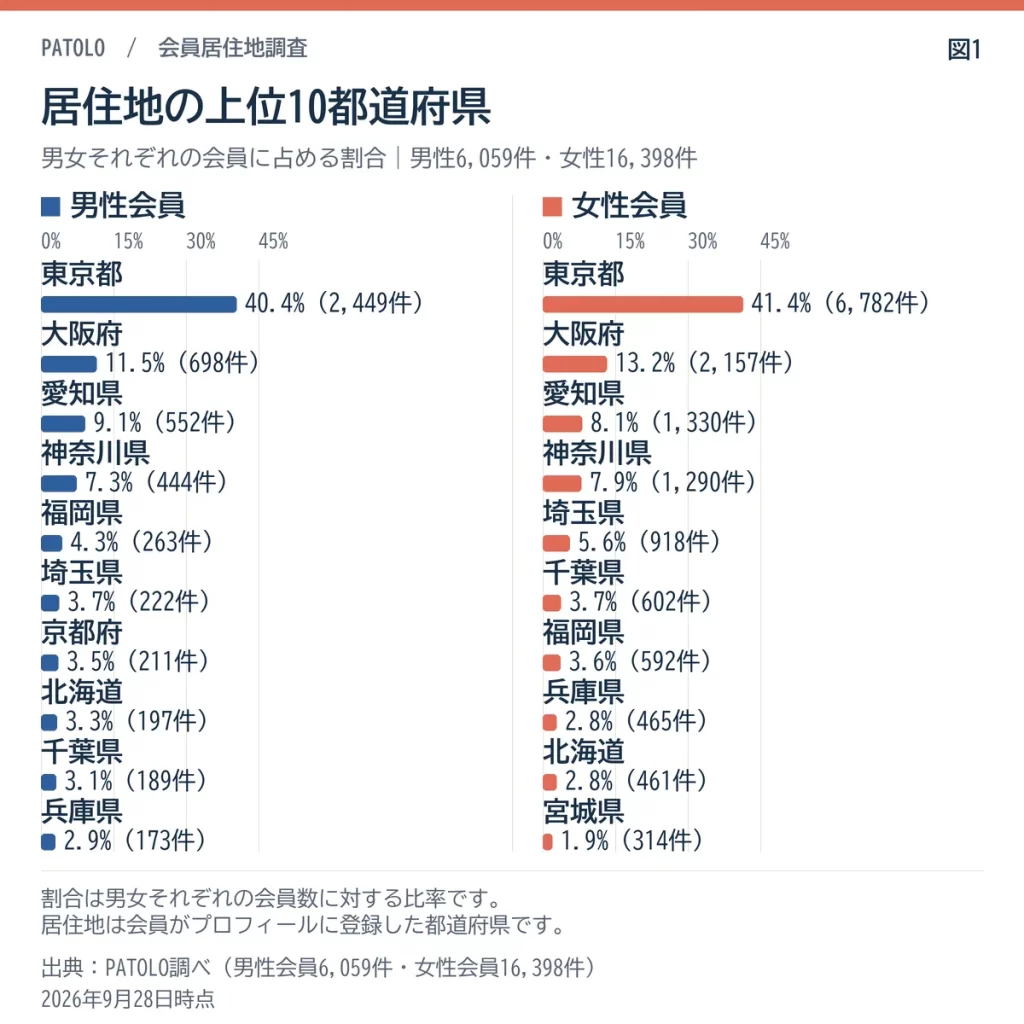
The largest number of members were in Tokyo, with 2,449 males (40.4%) and 6,782 females (41.4%).
The rankings for Osaka Prefecture (11.5% for men, 13.2% for women) in second place and Aichi Prefecture (9.1% for men, 8.1% for women) in third place are the same for both men and women. When these three prefectures are combined, the figures are 61.0% for men and 62.6% for women.
The rankings from 4th place onwards differ slightly between men and women. For men, the order was Kanagawa, Fukuoka, and Saitama prefectures, while for women, it was Kanagawa, Saitama, and Chiba prefectures.
Nine of the top 10 prefectures are the same for both men and women, with Kyoto Prefecture ranking in the top 10 for men and Miyagi Prefecture ranking in the top 9 for women.
| Ranking | Male member | Female member |
|---|---|---|
| 1 | Tokyo 2,449 cases (40.4%) | Tokyo 6,782 cases (41.4%) |
| 2 | Osaka Prefecture: 698 cases (11.5%) | Osaka Prefecture: 2,157 cases (13.2%) |
| 3 | Aichi Prefecture: 552 cases (9.1%) | Aichi Prefecture: 1,330 cases (8.1%) |
| 4 | Kanagawa Prefecture: 444 cases (7.3%) | Kanagawa Prefecture: 1,290 cases (7.9%) |
| 5 | Fukuoka Prefecture: 263 cases (4.3%) | Saitama Prefecture: 918 cases (5.6%) |
| 6 | Saitama Prefecture: 222 cases (3.7%) | Chiba Prefecture: 602 cases (3.7%) |
| 7 | Kyoto Prefecture: 211 cases (3.5%) | Fukuoka Prefecture: 592 cases (3.6%) |
| 8 | Hokkaido: 197 cases (3.3%) | Hyogo Prefecture: 465 cases (2.8%) |
| 9 | Chiba Prefecture: 189 cases (3.1%) | Hokkaido: 461 cases (2.8%) |
| 10 | Hyogo Prefecture: 173 cases (2.9%) | Miyagi Prefecture: 314 cases (1.9%) |
Looking solely at the figure of 4% being in Tokyo, it might seem as though the members are all from the city center.
On the other hand, about 60% of both men and women live outside of Tokyo. While it's true that the core of our membership is in the three prefectures of Tokyo, Osaka, and Aichi, we also have members in other regions.
We also note that the rankings are almost the same for men and women. Areas with a large number of male members also have a large number of female members, so we believe that the distribution of where people live does not differ significantly between men and women.
Result 2: By region, the Kanto region had over half of both men and women. The Chugoku and Shikoku regions had fewer.
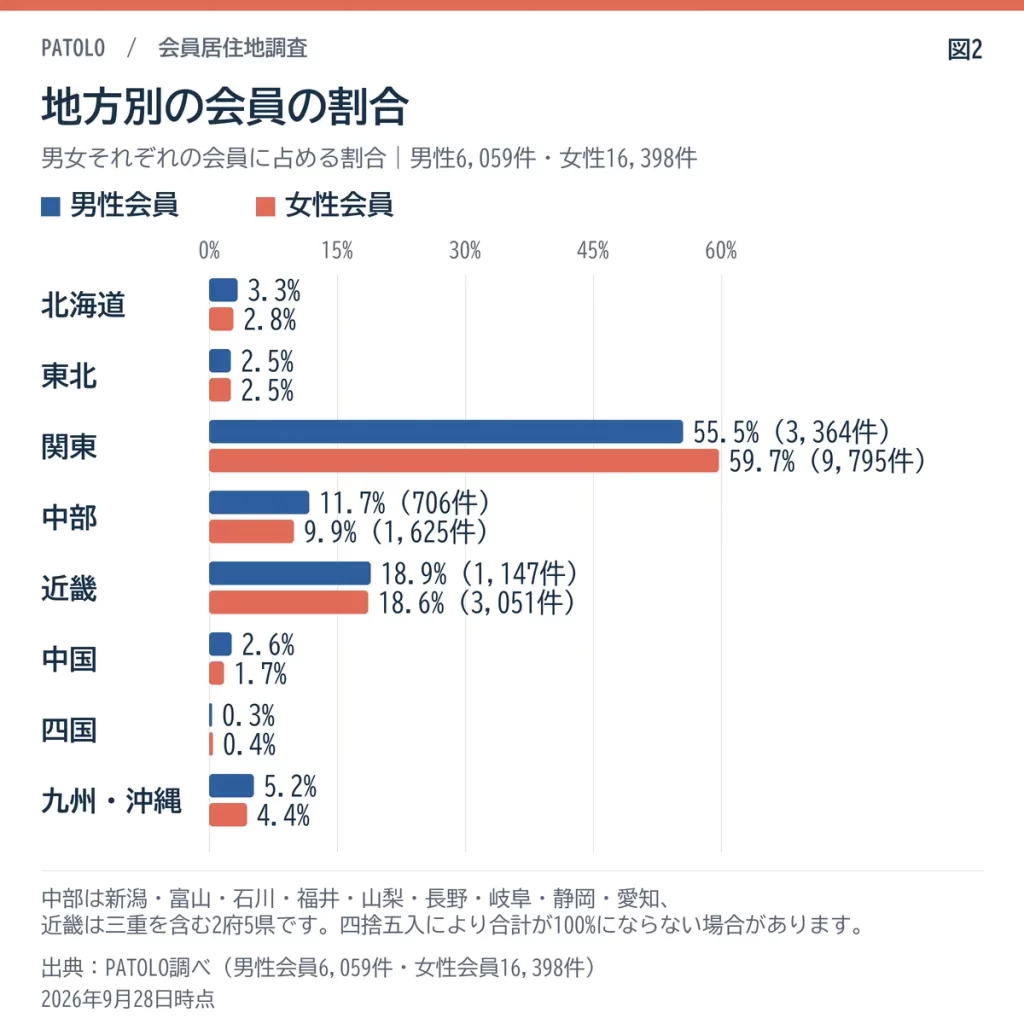
When the 47 prefectures are divided into eight regions, 55.5% of members are male and 59.7% are female in the Kanto region, with both genders exceeding half. This is followed by Kinki (18.9% male, 18.6% female) and Chubu (11.7% male, 9.9% female).
On the other hand, the Chugoku region (2.6% male, 1.7% female) and Shikoku region (0.3% male, 0.4% female) had low membership rates, with only 19 male members residing in Shikoku. The prefecture with the fewest members had only two for both men and women, indicating that while there are members in every prefecture, there are significant regional differences.
| Region | Male member | Female member | female ÷ male |
|---|---|---|---|
| Hokkaido | 197 cases (3.3%) | 461 cases (2.8%) | About 2.3 times |
| Tohoku | 151 cases (2.5%) | 402 cases (2.5%) | About 2.7 times |
| Kanto | 3,364 cases (55.5%) | 9,795 cases (59.7%) | About 2.9 times |
| Chubu | 706 cases (11.7%) | 1,625 cases (9.9%) | About 2.3 times |
| Kinki | 1,147 cases (18.9%) | 3,051 cases (18.6%) | About 2.7 times |
| Chugoku | 159 cases (2.6%) | 274 cases (1.7%) | About 1.7 times |
| Shikoku | 19 cases (0.3%) | 64 cases (0.4%) | Approximately 3.4 times (This is a reference value because the number of male cases is small). |
| Kyushu・Okinawa | 316 cases (5.2%) | 726 cases (4.4%) | About 2.3 times |
| Nationwide | 6,059 of | 16,398 of | About 2.7 times |
Even combining the Chugoku, Shikoku, Kyushu, and Okinawa regions, they only account for 8.2% of male members. Therefore, if you live in one of these regions and only search for a partner within your own prefecture, you should expect your options to be quite limited.
Most of our members in Kyushu and Okinawa live in Fukuoka Prefecture, those in Tohoku in Miyagi Prefecture, and those in Chugoku in Hiroshima Prefecture. In regional areas, members tend to be concentrated in the central cities of those regions.
I believe the number of people you can meet depends greatly on whether or not you can travel to a nearby central city.
Result 3 : There are approximately 2.7 times more female members than male members. The ratio varies by region.
Nationwide, there were approximately 2.7 times more female members than male members. This means there were roughly 2 to 3 female members for every 1 male member.
This ratio varies by region. Comparing the 12 prefectures with more than 100 members each for both men and women, Saitama Prefecture had the highest proportion of women, with 918 women compared to 222 men (approximately 4.1 times more men).
Chiba Prefecture (approximately 3.2 times) and Osaka Prefecture (approximately 3.1 times) follow. Conversely, Kyoto Prefecture (approximately 1.4 times) and Hiroshima Prefecture (approximately 1.6 times) have low ratios, even though the proportion of male members is higher than the national average.
The proportion of women is high in Saitama and Chiba prefectures, with Tokyo falling somewhere in between. While the data doesn't reveal the exact reason, it's possible that many female members live in neighboring prefectures that are easily accessible to Tokyo, assuming they will be meeting in Tokyo.
The male-female ratio doesn't directly reflect how easy it is to find someone. Even in areas with a high proportion of women, whether you can find someone who meets your criteria and is compatible with you depends on the individual.
We believe that the ratio should be viewed as a guideline for "how many potential partners there are in that area."
PATOLO Editorial Team's View | How to Find a Partner Based on Your Living Area
1. If you live in a rural area, broaden your search area to include nearby central cities.
Approximately 6% of our members live in Tokyo, Osaka, and Aichi prefectures, but we have members in all 47 prefectures. In rural areas, members are concentrated in central cities such as Fukuoka, Miyagi, and Hiroshima prefectures.
If you search not only within your own prefecture but also in nearby cities that you can easily travel to, you'll increase the number of people who can view your profile.
2. Focus on the conditions and compatibility rather than the male-female ratio.
There are approximately 2.7 times more female members than male members, but the ratio varies by region, from about 4.1 times in Saitama Prefecture to about 1.4 times in Kyoto Prefecture. However, it's not necessarily true that areas with a higher ratio are easier to find a partner in, or that areas with a lower ratio are harder to find a partner in.
I believe it's important to check each other's profiles and messages to determine how often you'll meet, how you'll spend time together, and whether your expectations are compatible.
3. Please state your place of residence up to the prefecture level. We will provide your specific address once we have established trust.
Your location in your profile can be a clue when searching for a partner. On the other hand, there's no need to disclose detailed information about your nearest train station or the area you live in early on.
When meeting someone for the first time, choose a public place, and only reveal your exact address after you've built a trusting relationship.
Survey overview
| Item | Message |
|---|---|
| Aggregation body | PATOLO Editorial Department |
| Reference date | As of April 2026, 9 |
| Target | PATOLO members |
| number | 6,059 male members, 16,398 female members (total 22,457 members) |
| method | The residential area (prefecture) of the member database profiles has been compiled by gender. |
| Properties of Values | Member self-declaration |
| fraction | Percentages are rounded to two decimal places, and multipliers are rounded to two decimal places. The total may not always equal 100%. |
About PATOLO
PATOLO is a screening-based matching service operated by UNIVERSE GROUP.
